
Keywords
Sikh shawls
kani shawls
colonial art history
Khalsa symbolism in textiles
How to Cite
Abstract
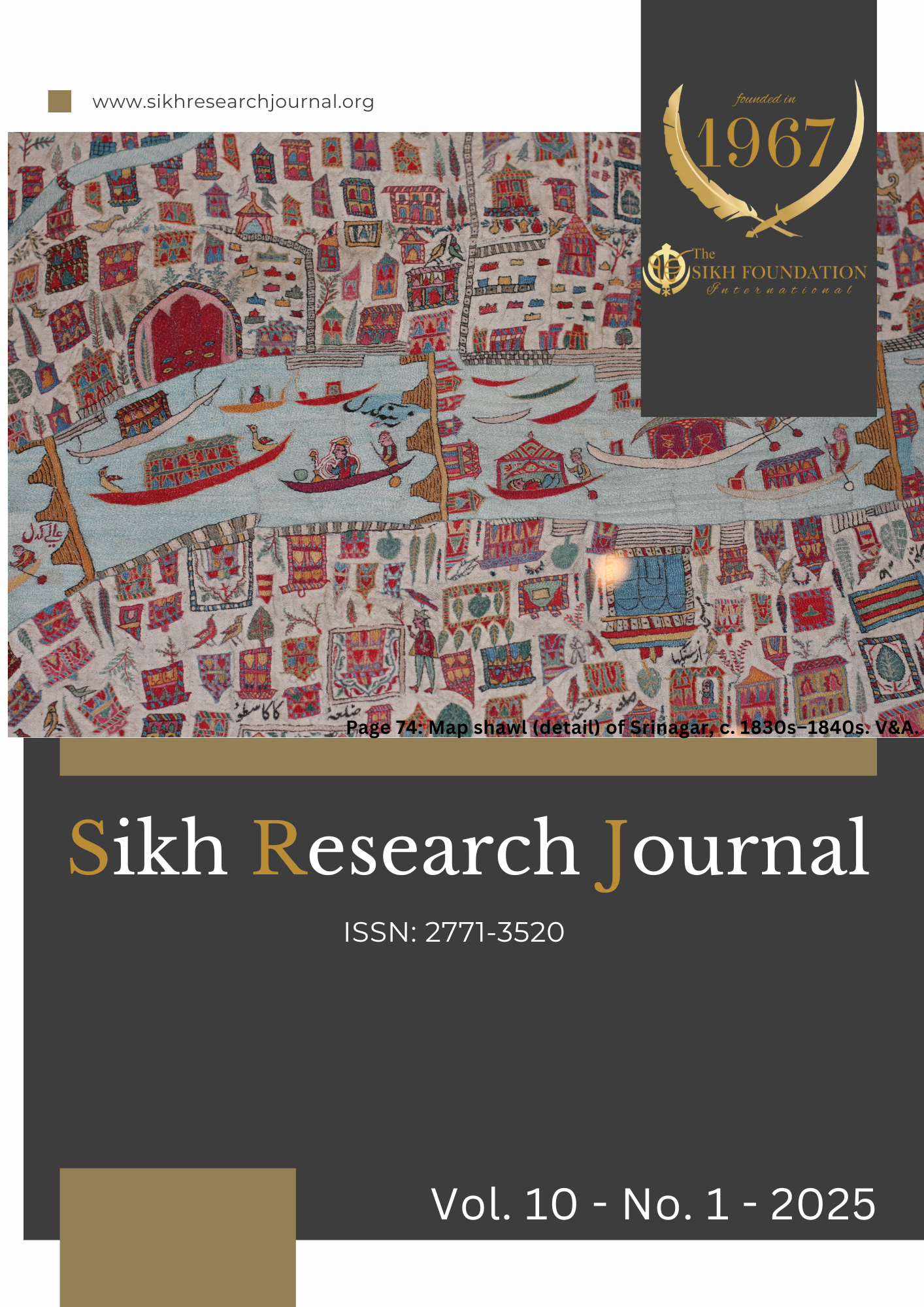
This essay challenges the long-held claim that European, particularly French, design influenced the Kashmir shawl during the early 19th century. Instead, it argues that the transformation in shawl motifs, marked by architectural, geometric, and Khalsa-inspired imagery, originated within the Sikh cultural and political milieu of Punjab under Maharaja Ranjit Singh. Drawing on French archival records, rare kani shawls, and regional history, the study affirms the Kashmir shawl’s indigenous evolution and rejects the notion of European artistic precedence.
References
Ames, F., The Kashmir Shawls and its Indo-French Influence. United Kingdom: ACC, 1997.
Ames, F., Woven Masterpieces of Sikh Heritage: The Stylistic Development of the Kashmir Shawl under Maharaja Ranjit Singh, 1780-1830. United Kingdom: ACC, 2010.
Ames, F., ‘Khalsa and Explosive Graphics in the Age of Maharaja Runjit Singh’s Kashmir’. Textiles Asia Journal, May 2011, vol. 3, issue 1.
Ames, F., ‘A Kashmir Paradigm Shift: Qajar and Zand Paintings as Evidence for Shawl Dating’. Hali, 2005, issue 139, pp. 70–75.
Ames, F., ‘Woven Legends: Carpets and Shawls of Kashmir 1585-1870’, The Arts of Kashmir, P. Pal (ed.) New York: Asia Society, 2007, pp. 192–209.
Ames, F., ‘A unique Mughal Kashmir Shawl at the Musée Guimet’. Orientations, October 2007, pp. 69–72.
Abul Fazl, Ain-i-Akbari, H. Blochmann (trans.). Calcutta: Asiatic Society of Bengal, 1873.
Archer, W.C., Paintings of the Sikhs. London: HMSO, 1966.
Bamzai, P.N.K., A History of Kashmir. New Delhi: Gulshan Press, 1973.
Bernier, François, Voyage dans les etats du Gran Mogol. Paris : Fayard, Burnes, Alexander, Travels into Bukhara, 1834
Chandra, Moti, ‘Kashmir Shawls’, Bulletin of the Prince of Wales Museum, vol. 3, 1954.
Deol, Jeevan, Illustration and Illumination in Sikh Scriptural Manuscripts," Marg Magazine, June 2003
Fenech, Louis E., ‘Ranjit Singh, The Shawl and the Kaukab-i Iqbal-i Punjab’, Sikh Formations, 2015.
Fichel, Moyse, Un mot sur le Cachemire des Indes et le Cachemire français. 1834, Paris
Goswamy, B.N., Piety and Splendour: Sikh Heritage in Art. New Delhi: National Museum, 2000 (Ex. Cat.).
Goswamy B.N. & C. Smith, I See No Stranger: Early Sikh Art and Devotion. New York: Rubin Museum, 2006 (Exh. Cat.).
Irwin, John, Shawls: A Study in Indo-European Influences. London: Victoria and Albert Museum, 1975.
Jacquemont, V., Correspondence de V. Jacquemont pendant son voyage dans l’Inde, 1828-1832, 2 vols. Paris, 1841.
Jacquemont, V., Voyage dans l’Inde, 4 vols. Paris 1841.
Jacquemont, V., Letters from India, 1829-1832. London: Macmillan and Co., 1936.
Khanuja, Dr. Parvinderjit Singh, Splendors of Punjab Heritage, with intro by Dr. Paul Michael Taylor (ed.). Delhi: Roli Books, 2022.
Jahangir, Tuzuk-i-jahangiri (memoires), Henry Beveridge (ed.)
Lafont, Jean-Marie, La presence française dans le royaume Sikh du Penjab: 1822-1849, Ecole Française d’Extrême-Orient. Paris, 1992.
Lafont, Jean-Marie, Indika : Essays in Indo-French Relations, 1630–1976. Pub’d: 2000 by Manohar Publishers in New Delhi.
Lafont, Jean-Marie, Maharaja Ranjit Singh: Lord of the Five Rivers. New Delhi: Oxford University Press, 2002.
Lévi-Strauss, Monique, Cashmere: A French passion 1800-1880. London: Thames & Hudson, 2013.
Lévi-Strauss, Monique, The Cashmere Shawl. Rome: Arnoldo Mondaldori, 1987.
Moorcroft, William, Travels in the Himalayan Provinces of Hindustan and Panjab; in Ladakh and Kashmir; in Peshawar, Kabut, Kunduz, and Bukhara, by Mr. George Trebeck and William
Moorcroft from 1819 to 1825. London, 1841, 2 vols.
Stronge, Susan (ed.), The Arts of the Sikh Kingdoms. London: Victoria and Albert Museum, 1999

This work is licensed under a Creative Commons Attribution-NonCommercial-ShareAlike 4.0 International License.
Copyright (c) 2025 Frank Ames